Key takeaways >- You are selling a service, not software. AI startup templates lead with a product demo and a free trial. You have neither. Copying that structure is the most common reason an automation agency's site does not book calls.- Target bigger firms than you think. AI investment runs at 24% among businesses with 1–9 employees, 45% at 10–49, and 75% at 75+ (Business.com/Dialog survey of 1,009 US workers at firms of 2–250 employees). The solopreneur market you are probably writing for is the least likely to buy.- Adoption is no longer the objection. 89% of small businesses now use AI in some capacity, up from 36% in 2023 (U.S. Chamber of Commerce, Empowering Small Business). Your homepage does not need to sell AI. It needs to sell you.- The page that converts answers one question fast: what specific process will you automate, and what did it save someone like me.
The head query behind this page is unusually literal — people search ai automation agency website layout that converts clients. They are not browsing. They have an agency, they have a site that is not booking calls, and they want the structure.
Why AI startup templates misfire
Walk through what an AI product site does. It leads with a live demo or a product screenshot. It offers a free trial. It shows integrations, pricing tiers, and a signup form. The whole page is engineered to get someone into the software without talking to a human.
You are running the opposite business. There is no product to try. The thing being bought is your judgement about which process to automate and your ability to keep it running. A trial button is meaningless, and a pricing tier is often actively harmful, because scope varies per client.
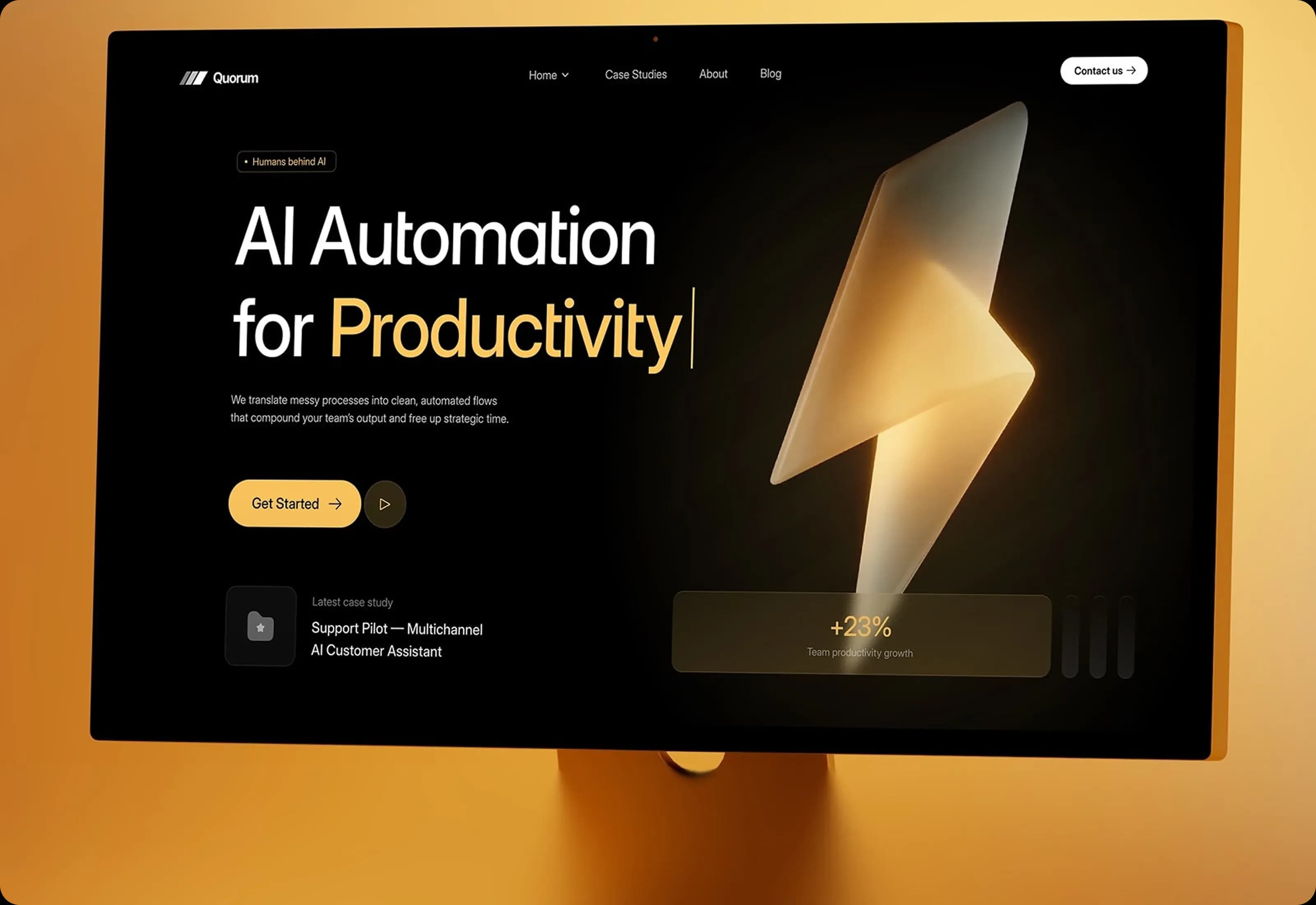
When an automation agency drops its logo into a SaaS template, three things break:
- The hero promises a product. "Automate everything with AI" reads as software. Visitors look for the app, find a contact form, and leave.
- The proof section is wrong. SaaS sites prove with integration logos. Service buyers want a before/after on a process they recognise.
- The CTA is too small a step. "Start free" costs nothing and means nothing. "Book a 20-minute automation audit" is the real conversion event.
Who actually buys automation
This is where most positioning advice goes wrong, and the data is unambiguous.
A Business.com and Dialog survey of 1,009 US workers at companies with 2–250 employees found AI investment climbing sharply with headcount:
Company size | Investing in AI |
|---|---|
1–9 employees | 24% |
10–49 employees | 45% |
75+ employees | 75% |
A firm with 75 or more people is more than three times as likely to be investing as a firm under ten. That inverts the instinct to chase solo operators and very small businesses, who are cheap to reach and rarely have either the budget or the repeatable process volume that makes automation pay.
It also tells you what the site has to look like. A 75-person company has someone accountable for the decision, usually an ops or finance lead. They will want to know how you handle access to their systems, what happens when an automation breaks, and who owns the workflows afterwards. A page written for a solopreneur answers none of that.
The wider context supports the same move. 89% of small businesses now use AI in some capacity, up from 36% in 2023 — the U.S. Chamber of Commerce calls it the fastest technology uptake it has tracked since social media. You are no longer arguing that AI is worth using. That argument is over, and a homepage still making it sounds two years late.
The page structure that fits
Six sections, in this order. The logic is that a service buyer needs qualification before proof, and proof before price.
1 · Hero: name the process, not the technology
The strongest hero states a specific, recognisable workflow and its outcome. "We automate quote-to-invoice for construction firms — usually 10–15 hours a week back" beats "AI-powered business automation" because it lets the wrong visitor leave and the right one keep reading.
Avoid naming your tools here. Whether you build in n8n, Make or custom code is an implementation detail, and leading with it invites a buyer to price-shop against a freelancer who lists the same tool.
2 · The problem, in their words
One short section describing the manual process you replace, written the way the client describes it internally — "someone re-types the order into the accounting system" — not the way you describe it. This is the section that makes a visitor feel understood, and it is the one most agency sites skip.
3 · Proof: one worked example, with numbers
A single before/after carries more weight than five logos. State the process, the time or error rate before, the time after, and how long the build took. If you cannot yet cite a client by name, an anonymised case ("a 60-person logistics firm") still works, provided the numbers are real.
Do not pad this with tool logos. Zapier's logo proves nothing about you.
4 · How you work
The section that closes the operational buyer. Cover access and permissions, what your handover looks like, who maintains the automation, and what happens when an upstream API changes. Agencies lose deals here silently — the buyer imagines being stranded with a broken workflow nobody understands and stops replying.
5 · Scope and price signalling
Full price tiers rarely survive contact with real scope. A starting-from figure and a typical range do the qualification work without boxing you in: "most first engagements run $4,000–$9,000 and take three to five weeks." Silence on price filters out serious buyers as effectively as a wrong number does.
6 · One CTA, repeated
An automation audit or a scoping call. Same wording every time it appears. Multiple competing CTAs — book a call, download a guide, join a newsletter — split intent and reduce all three.
What to cut
Common section | Why it hurts |
|---|---|
Tool logo wall (n8n, Make, Zapier) | Proves the tools exist, not that you are good. Invites price comparison with freelancers. |
"What is AI automation?" explainer | The adoption data says your buyer already knows. This section signals you are pitching beginners. |
Live chatbot as the main demo | A chatbot on your own site is not evidence you can rebuild someone's back office. |
Generic stock imagery of robots | The fastest way to look like every other agency in the category. |
Blog with three posts from 2024 | An empty content section reads as an abandoned business. Remove it until you will maintain it. |
Starting from a template
The structural requirement is a services layout with strong case-study support — not a SaaS product page. If you are building in Framer, the templates worth looking at are the ones designed to explain something technical without a product to show. Neurolinx ($59) is built for AI and machine-learning companies and leads with a statement hero and a feature grid, which adapts cleanly to a services framing. APIQ ($59) is built for developer tools and API products, and its documentation-style modular layout suits agencies that need to explain a technical process in sequence.
If you want the wider set of options, our agency portfolio guide covers structure for service businesses generally, and AI website templates covers the product-company side if that is genuinely what you are building.
Frequently asked questions
What should an AI automation agency put on its homepage? A specific process and its outcome in the hero, the client's description of the manual problem, one worked example with real numbers, an explanation of how you handle access and handover, a starting price range, and a single repeated CTA for a scoping call.
Should I show my pricing? Show a range, not tiers. Scope varies too much for fixed packages, but complete silence on price filters out serious buyers who need to know whether you are a $3,000 or a $30,000 engagement before they spend time on a call.
Which businesses should an automation agency target? Firms above roughly 10 employees, and ideally above 50. AI investment runs at 24% among 1–9 employee businesses versus 75% at 75+ (Business.com/Dialog). Larger firms also have the repeatable process volume that makes an automation pay for itself.
Do I need to explain what AI automation is? No. 89% of small businesses already use AI in some form, up from 36% in 2023 (U.S. Chamber of Commerce). An explainer section signals that you are pitching to beginners and costs you credibility with the operational buyer who actually signs.
Can I use an AI startup template for an automation agency? Only if you restructure it. Startup templates are built around a product demo, a free trial and pricing tiers, none of which you have. Keep the visual design, replace the product sections with a case study and a "how we work" section.
Sources
- U.S. Chamber of Commerce — Empowering Small Business: The Impact of Technology on U.S. Small Business. AI use at 89%, up from 36% in 2023. Retrieved 1 September 2026.
- Business.com — 2026 Small Business AI Outlook Report, survey of 1,009 US workers at firms of 2–250 employees, conducted with Dialog. Investment by company size. Retrieved 1 September 2026.


